
update Updated 20 May 2025
category Climate change adaptation News
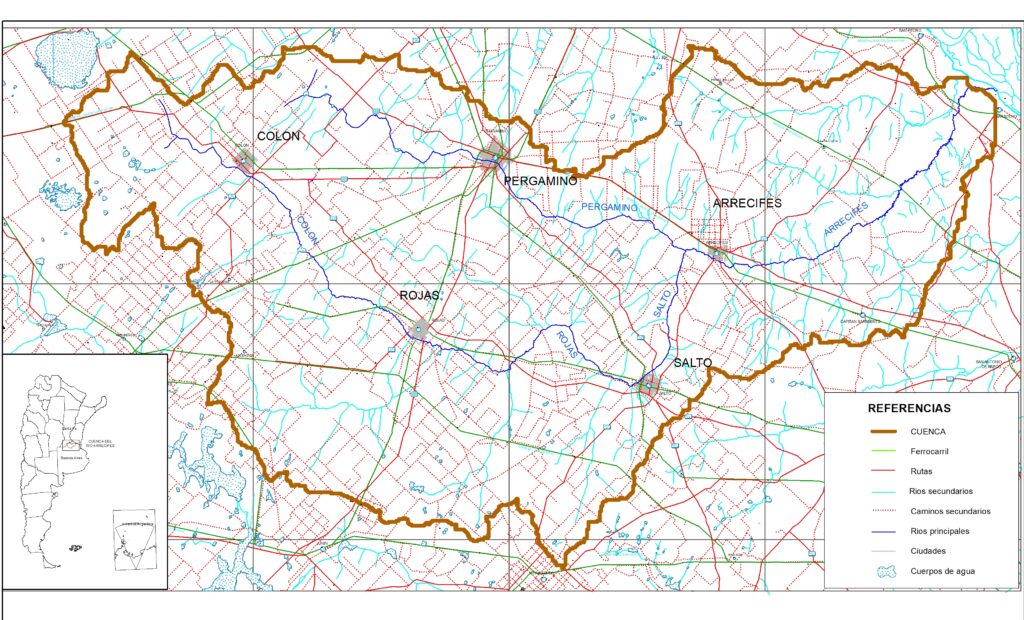
The Arrecifes River basin covers 11,328 km² in the provinces of Santa Fe and Buenos Aires, Argentina. Its climate is temperate, with an average annual temperature of 15°C and rainfall ranging between 600 and 1,000 mm per year.
The Arrecifes River Basin Committee commissioned the National Water Institute to conduct a study aimed at providing an integrative vision. Natural issues such as floods and droughts, as well as their impact on the basin, were analyzed. Human intervention was also assessed, considering the occupation of the floodplain in major cities and changes in land use, where soybean cultivation has become a key agricultural activity.
The study diagnosed the influence of climate change on rainfall patterns and runoff processes, which have been affected by land use transformation. It was found that periods of water excess are critical both for population safety and productive areas.
Special attention was given to the Pergamino Stream, a tributary of the Arrecifes River. Specific studies were conducted to evaluate flooding in Pergamino and its vast rural area, highlighting the severe situation of April 1995, which caused significant human and economic losses.
The study proposed structural measures at the basin level, including actions on watercourses, correction of road interferences, and the construction of a flood control dam on the Pergamino Stream. The Basin Committee is responsible for evaluating and implementing these actions, coordinating technical and economic management with provincial water resource authorities.
Daniel Bacchiega, Daniel Barrionuevo and Claudio Fattor, Hydraulics Laboratory of the National Water Institute.