update Updated 9 July 2026
category News
Following four days of debates, technical discussions and institutional meetings, the 2026 World Basin Summit concluded last week in Rio de Janeiro with a clear message: in the face of the accelerating impacts of climate change and the need to adapt to them, numerous strategic, technical and operational solutions must be discussed and shared, at all levels, to ensure water security and strengthen the resilience of regions.
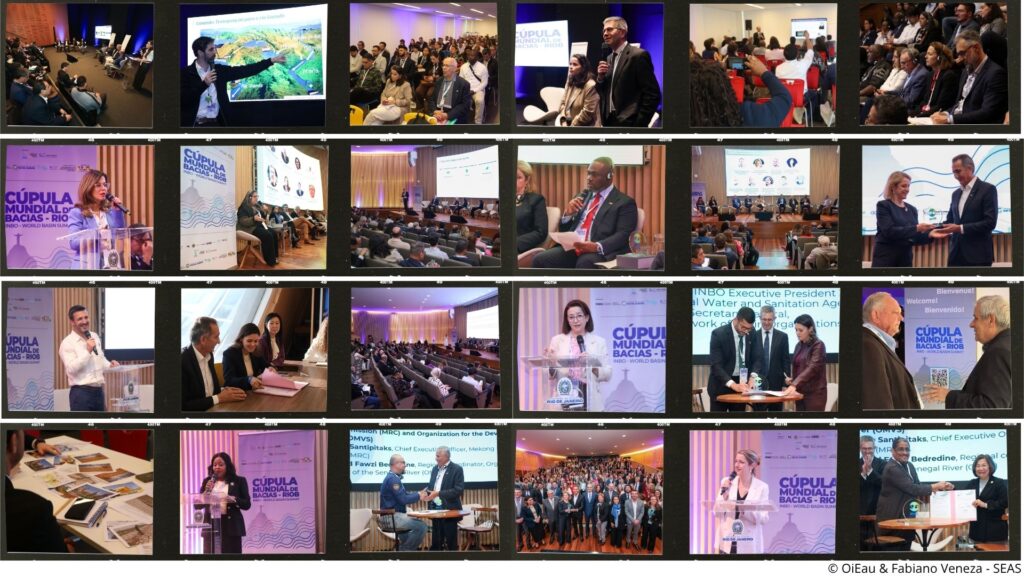
Organised by the International Network of Basin Organizations (INBO) and the Rio de Janeiro State Secretariat for the Environment and Sustainability, the Summit brought together nearly 400 participants from 48 countries, including ministers, government representatives, river basin organisations, scientists, international institutions and civil society actors committed to the sustainable management of water resources.
Hosted at the Museu do Amanhã and the Museu de Arte do Rio (MAR), participants discussed the major challenges facing river basins against a backdrop of increasingly severe droughts, floods and pressure on water resources.
Concrete solutions to global challenges
Throughout the Summit, discussions focused on several strategic issues: the modernisation of hydrological observation and forecasting systems, theadaptation of river basins to extreme weather events, strengthening the dialogue between cities and river basins, the restoration of aquatic ecosystems and accelerating the transition to acircular water economy.
The discussions confirmed the central role of river basin governance as a tool for coordinating different water uses, preventing risks and adapting to climate change.
Speakers also emphasised the need to step up international cooperation in order to share knowledge, pool experiences and accelerate the implementation of operational solutions.
Brazil takes over the presidency of INBO
The closing ceremony was also marked by the official handover of the INBO presidency.
On behalf of France, which had held the presidency of the network since 2024, Ms Barbara Pompili, France’s Ambassador for the Environment, handed over the presidency to Brazil, represented by H.E. Mr Waldez Góes, Minister for Integration and Regional Development.
The 2026 World Basin Summit thus drew to a close on a shared conviction: in the face of increasingly global challenges, solidarity between river basins, knowledge-sharing and international and cross-border cooperation remain the cornerstones of a more resilient future for water and territories.
From Rio de Janeiro 2026 to Windhoek 2028
At the close of the conference, participants were invited to continue this momentum of exchange and dialogue at the next edition of the World Basin Summit, to be held in Namibia in 2028.
H.E. Ms Selma Nghinamundova, Namibia’s Ambassador to Brazil, announced during the INBO statutory session that the Namibian capital, Windhoek, will host this international event.
Following on from Latin America, the fact that this forthcoming edition of the Summit is to be held in Africa demonstrates the continent’s commitment to the challenges of international cooperation on water and sustainable development.
The Peer-to-Peer project: an innovative and operational collaboration between basin organisations
Among the flagship initiatives presented in Rio de Janeiro, INBO’s Peer-to-Peer (P2P) project provided a concrete illustration of the importance of direct exchanges between river basin organisations.
Supported by the European Union and implemented with the backing of the African Network of Basin Organisations (ANBO), this programme fosters partnerships between basin organisations from different regions of the world in order to share practical solutions to common water and climate-related challenges.
The interactive workshops organised during the Summit enabled project participants to present the initiative’s initial results and to highlight the benefits of cooperation based on mutual learning. Drought management, flood prevention, water governance, hydrological information systems, financing for integrated water resources management and Nature-based Solutions were among the topics discussed.
The Summit also provided an opportunity to formalise two new partnerships through the signing of memoranda of understanding (MoUs). The first was concluded between the Organisation for the Development of the Senegal River (OMVS) and the Secretariat of the Mekong River Commission (MRCS), two rivers that epitomise the challenges of hydro-diplomacy and transboundary water resource management. The second was signed between the Autonomous Binational Authority for the Lake Titicaca Water System (ALT) and the Authority for the Sustainable Management of the Lake Atitlán Basin and its Environment (AMSCLAE) in Guatemala, which have placed data and information systems – vital decision-making tools – at the heart of their joint action plan.
To find out more, look out for the conference report and video interviews with speakers and participants, coming soon to the INBO website!